
 COLLEGE OF ENGINEERING
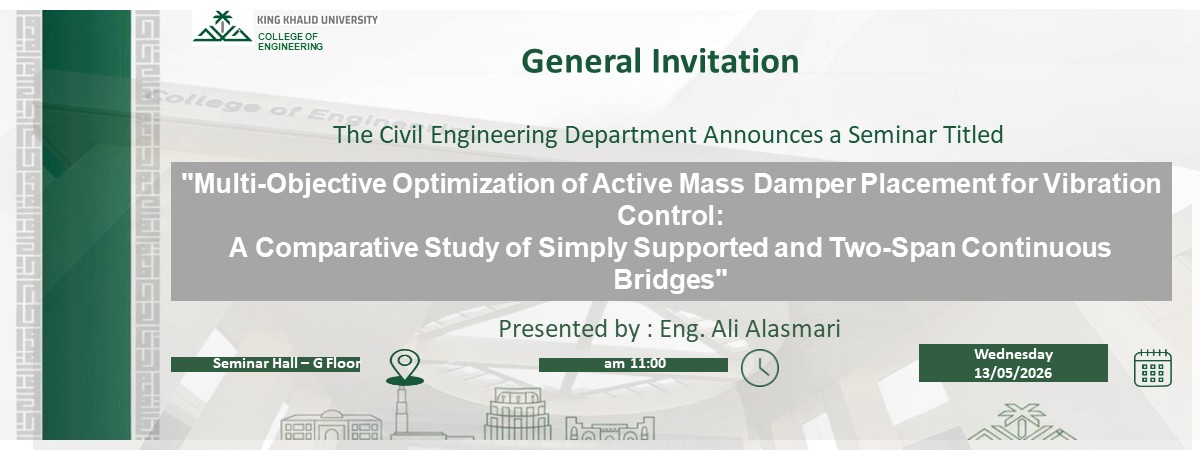
Seminar: Multi-Objective Optimization of Active Mass Damper Placement for Vibration Control
This research presents a comprehensive investigation into vibration control in modern bridge structures, focusing on the application of Active Mass Dampers (AMDs) as an advanced solution for mitigating dynamic responses. The study addresses the increasing vulnerability of long-span and flexible bridges to dynamic loads such as traffic, wind, and seismic excitations. A comparative analysis is conducted between simply supported and two-span continuous bridge configurations to evaluate how structural continuity influences control effectiveness. A finite element modeling approach based on Euler–Bernoulli beam theory is developed and implemented in MATLAB to simulate the dynamic behavior of both bridge types. To enhance system performance, a multi-objective optimization framework using the NSGA-II genetic algorithm is applied to determine optimal damper placement, control parameters, and system efficiency. The results demonstrate that structural configuration plays a critical role in vibration mitigation, with continuous bridges showing superior performance and higher efficiency in control energy usage. The study highlights that optimal damper placement is more influential than simply increasing the number of devices. This research provides practical engineering guidelines for cost-effective deployment of active control systems and emphasizes the importance of integrating smart vibration control strategies in the early design stages of modern bridges to enhance safety, durability, and long-term performance.